
Original Clubhouse
Working Roots: The Original PYC Clubhouse
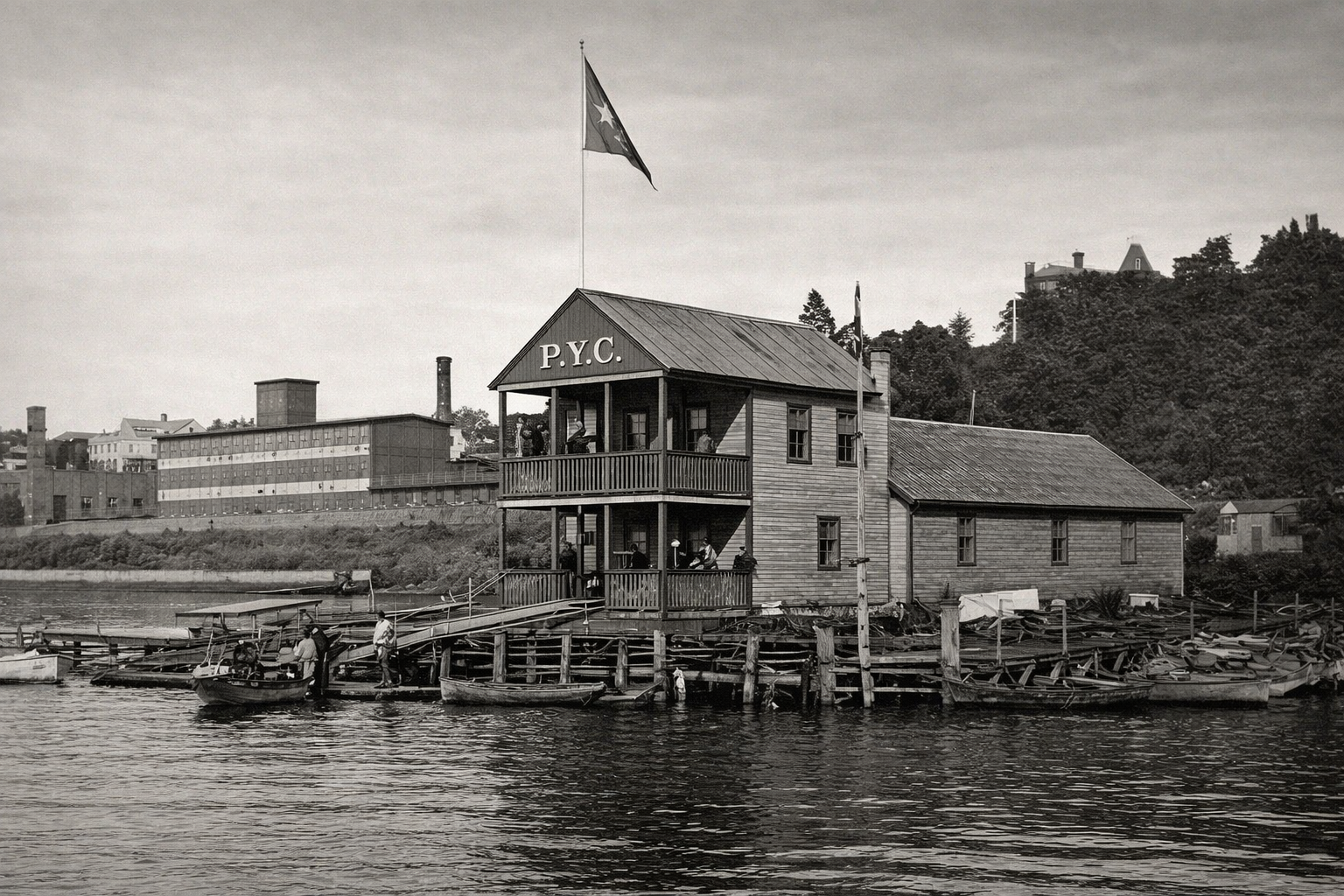
Digitial Enhanced photo created by Michael Quick (PYC Historical)
The building shown here is the original clubhouse of the Poughkeepsie Yacht Club, founded in 1892 by a group of local boating enthusiasts and working sailors. The club’s first home stood on the Poughkeepsie waterfront near lower Main Street, at Shipyard Point—later known as Fox’s Point—on a dock leased from the New York Central and Hudson River Railroad for $25 a year. The first clubhouse was completed by May 1893. It was a modest 20-by-20-foot, two-story wooden structure, built close to the river and designed more for function and fellowship than grandeur. In 1897, the front veranda was added through fundraising efforts, including proceeds from the club’s “Autumn Carnival.” The club later moved to a second clubhouse in 1905 after being forced to relocate from the original site.
From the beginning, the Poughkeepsie Yacht Club had the reputation of being a “working man’s club.” It was not built around luxury, but around shared effort, boating, and camaraderie - A legacy which remains to this day. Members raced, rowed, sailed, and even ice-boated, and the straight stretch of the Hudson between Poughkeepsie and Hyde Park was considered one of the finest racing reaches in the country in the late nineteenth century. Early club life centered on the river: members gathered on the porches to watch the water, tend to club business, and enjoy the social side of boating in a setting that was both humble and deeply connected to the waterfront.
Available club histories list Powell Hobert as the first commodore, serving from 1892 to 1894 during the club’s formative years. That places him at the helm when the organization was first established and when the original clubhouse was built. His tenure belongs to the earliest chapter of the club’s history, when the Poughkeepsie Yacht Club was still defining itself as one of the oldest boating institutions on the Hudson River and beyond.
To have a boat at the club in those early years would have been a far more hands-on experience than at a modern marina. Members typically kept small sailboats, rowboats, and later small launches tied to docks or moorings, and much of the maintenance and upkeep was done by the members themselves. That tradition of member participation remained a defining part of the club’s culture: the club describes itself as being run “by and for the members,” with members contributing labor to maintain docks, care for the clubhouse, support events, and keep costs low. In that sense, boat ownership at the club was not just about having a place to keep a boat—it meant belonging to a boating community in which everyone helped build, sustain, and enjoy the life of the club together.
- Michael Quick (PYC Historical)